

Estimated read: 6 minutes. The most counterintuitive mechanism in human performance physiology — and why nasal breathers feel different than mouth breathers, every single day.

The forgotten side effect of nasal breathing
Most discussions of nasal breathing focus on the obvious benefits: better airflow, more nitric oxide, deeper sleep. Those are real and worth caring about.
But there's one effect that almost nobody talks about — and it's the one that gets nasal breathers hooked on the practice within the first week. It has nothing to do with sleep or training pace. It has to do with how your brain feels.
It's called CO₂-induced cerebral vasodilation. And it's the closest thing to a "free runner's high" the human body comes with.
The mechanism, in plain language
Here's what's happening:
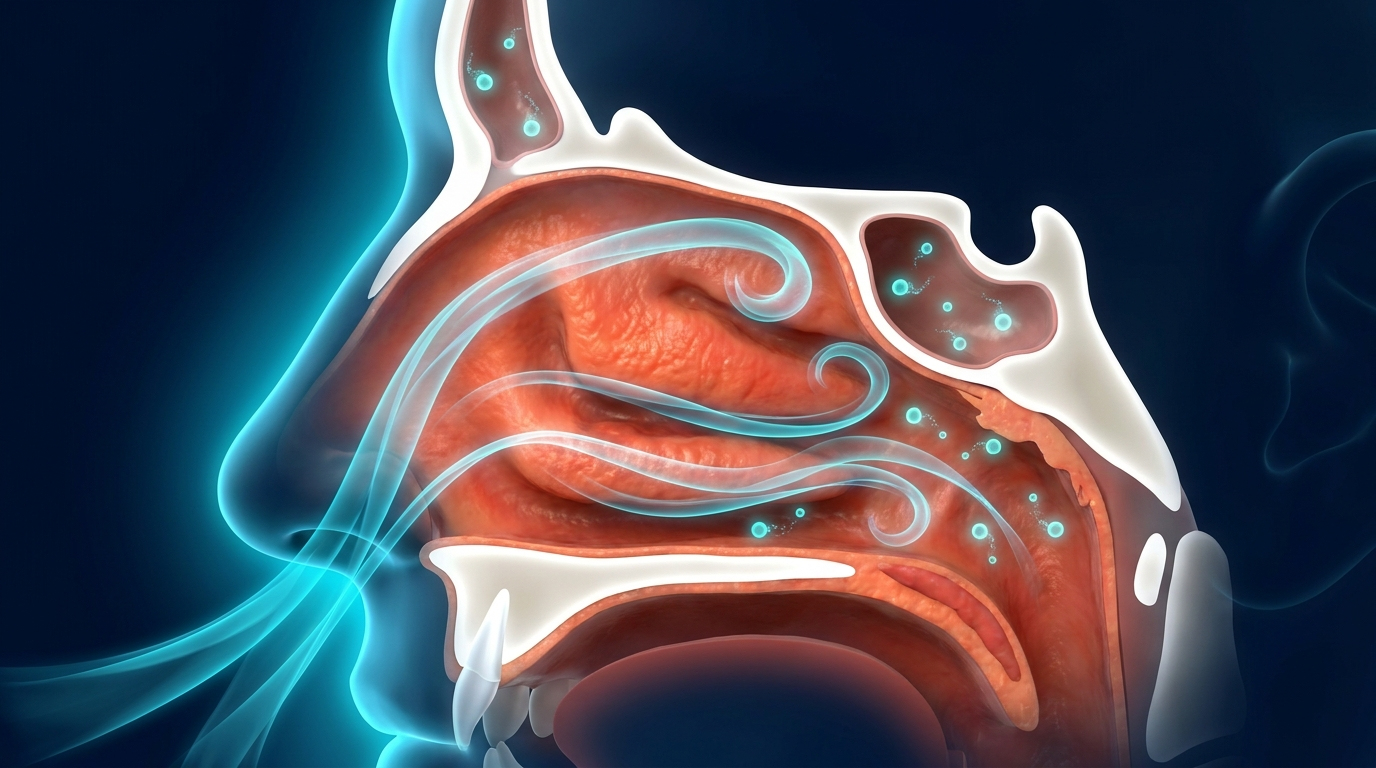
- When you breathe through your nose, your airway is narrower than your mouth. You inhale less air per breath.
- Lower air volume means less CO₂ gets exhaled with each breath.
- So nasal breathers carry more dissolved CO₂ in their blood than mouth breathers — at rest, during exercise, during sleep.
- Carbon dioxide is a powerful vasodilator in the cerebral arteries. Higher blood CO₂ = wider blood vessels in the brain.
- Wider cerebral vessels = more blood, more oxygen, more glucose reaching brain tissue.
The subjective experience: a mild warm-headed feeling. Slight euphoria. Clearer thinking. Some people describe it as "the second cup of coffee" feeling without the caffeine spike. Others say it feels like the calm clarity you get 30 minutes into a long run.
Mouth breathers don't get it. They offload CO₂ too aggressively. Their cerebral vessels are constantly slightly constricted. Less blood, less oxygen, less glucose — for hours every day, for years, for life.
The science behind it
This isn't fringe physiology. CO₂-induced cerebral vasodilation has been documented in medical literature since the 1940s. It's the reason hyperventilation — which lowers blood CO₂ — makes you lightheaded and tunnel-visioned: your cerebral arteries constrict, brain perfusion drops. The reverse — slow nasal breathing — does the opposite.
Freediving athletes use this mechanism intentionally to extend breath holds. Buteyko Method practitioners measure CO₂ tolerance via the BOLT score test. Patrick McKeown's The Oxygen Advantage trains athletes to raise their CO₂ tolerance, partly because higher baseline CO₂ improves cerebral perfusion and partly because it improves oxygen delivery via the Bohr effect.
James Nestor describes this in Breath as one of the underrecognized benefits of slow nasal breathing protocols — a mild, sustained euphoria that meditators, monks, and freedivers have known about for centuries.
Why this matters for athletes
Cerebral perfusion isn't just a comfort thing. It affects:
- Cognitive performance under fatigue — better-perfused brains stay sharper when blood glucose drops late in a workout or race
- Pacing decisions in endurance events — clearer thinking translates to better fueling and pacing choices in hour 3 of a marathon
- Recovery quality — cerebral blood flow during sleep is implicated in glymphatic clearance (the brain's overnight clean-up system)
- Stress recovery — slow nasal breathing activates the parasympathetic nervous system, and the vasodilation effect compounds this
It's the closest thing to legal performance enhancement we have. And it costs nothing.
How to feel it yourself, tonight
The fastest way to experience CO₂-induced cerebral vasodilation:
- Sit in a chair. Close your mouth. Breathe through your nose only.
- Slow your breathing dramatically. Aim for inhale 4 seconds, exhale 8 seconds.
- Do this for 5 minutes uninterrupted.
- Notice: somewhere between minute 2 and minute 4, you'll feel a subtle warm sensation in your head. That's blood arriving where it usually doesn't.
If you don't feel it, your CO₂ tolerance is likely too low — your body is panicking at the higher CO₂ levels and overriding the protocol. The fix: do this practice nightly for two weeks. By the end of week 2, you'll feel it in 90 seconds.
The cheat code most people skip
The single largest leverage point for cerebral vasodilation: nasal breathing during sleep.
Eight hours of mouth breathing every night undoes whatever cerebral perfusion gains you accumulate during the day. Sleep is when your brain does its most demanding work — memory consolidation, glymphatic clearance, hormone regulation. It needs the blood flow.
This is the case for nasal strips. A Strapflow strip across the bridge of your nose for 8 hours of sleep, every night, raises your average cerebral blood flow more than any nootropic, supplement, or biohack on the market.
Black 30-Pack — one month of nightly nasal breathing — $17.90 →
The trade-off (because there is one)
If you have severe nasal congestion, anatomical airway issues (deviated septum, polyps), or untreated sleep apnea, this protocol isn't a substitute for medical care. Talk to an ENT first.
For everyone else: this is one of the highest-leverage, lowest-cost, most under-discussed performance levers your body comes with. Nestor wrote a book about it. McKeown trains Olympic teams with it. The Buteyko researchers documented it 70 years ago.
Now you know.
Sources
- Lassen NA — "Cerebral blood flow and oxygen consumption in man." Physiological Reviews, 1959. The foundational cerebral perfusion paper.
- Patrick McKeown — The Oxygen Advantage, 2015
- James Nestor — Breath, 2020
- Dr. Konstantin Buteyko — Foundational research on CO₂ tolerance, 1950s–1980s

Leave a comment
This site is protected by hCaptcha and the hCaptcha Privacy Policy and Terms of Service apply.