
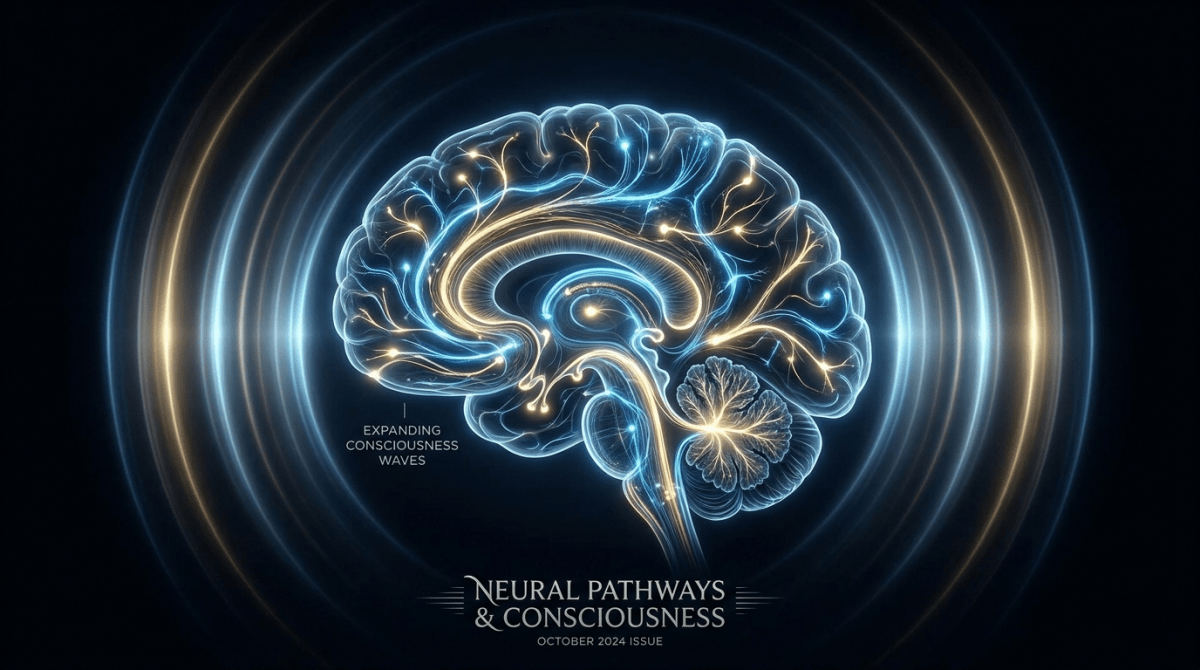
Read time: 9 minutes. The DMT-release breathing protocol — what's claimed, what's documented, how to do it safely, and the difference between holotropic breathwork, "DMT breathing," and traditional Hindu pranayama. Important: this is a guide to a strong nervous-system practice. Read the safety notes.
What "DMT breathing" actually refers to
You'll see "DMT breathing" used loosely online to describe at least three distinct practices:
- Holotropic Breathwork™ — developed by Stanislav Grof in the 1970s as a non-pharmacological alternative to psychedelic therapy. 2–3 hours of deep, rhythmic breathing paired with intense music. Produces altered states.
- Pranayama practices from traditional Hindu yoga — Kapalabhati ("skull-shining breath"), Bhastrika ("bellows breath"), and breath retention practices (kumbhaka) that classical yogic texts associate with profound states of consciousness.
- Modern internet "DMT breath" videos — typically a fast deep-breathing pattern followed by long retention. Often described as a way to "release endogenous DMT" — a claim that's not currently supported by peer-reviewed research, but produces real, measurable altered states regardless of the mechanism.
What's actually happening physiologically
The altered states produced by these practices are real and reproducible. The mechanism is well-documented, though not necessarily DMT-mediated:
- Respiratory alkalosis — extended hyperventilation lowers blood CO₂, raises blood pH, narrows cerebral arteries. Produces the tingling, mild dissociation, and tunneling that practitioners describe.
- CO₂-induced cerebral vasodilation rebound — when you stop hyperventilating, CO₂ builds back up, blood vessels in the brain dilate, blood floods the cortex. Mild euphoria, warmth, perceptual shifts. Full science here.
- Default Mode Network suppression — same brain network suppressed by psilocybin and LSD. Quiets the "self-narrative" voice.
- Endogenous opioid + endocannabinoid release — well-documented after extended breathwork sessions.
- Possible role of endogenous DMT — the human body produces trace amounts of N,N-DMT in the lungs and pineal gland. Whether breathwork meaningfully raises serum levels is unproven. The altered state happens regardless.
Safety first — this is not a casual practice
Do not do this if:
- You have cardiovascular issues, hypertension, or arrhythmia
- You're pregnant
- You have a history of seizures or psychotic episodes
- You're alone for the first several sessions — have a sober person present
- You're in or near water, or driving, or operating machinery
People do faint, cry, laugh uncontrollably, experience body shaking (tetany), and have intense emotional release during these sessions. That's the practice working. It also means you don't want to be standing.
A safer entry-level protocol
If you're new to this, start with Wim Hof Method (which is shorter and more bounded). When ready to do something deeper, this is the standard entry-level holotropic-style session:
Setup (15 min)
- Lie down on a yoga mat with a meditation cushion under your knees and another under your head. Eye mask helps.
- Have a sober sitter present — someone who will not leave the room.
- Apply a Strapflow nasal strip — the deep breathing for 60+ minutes is sustainable only if your nasal airway is fully open. Mouth breathing for an hour straight dries you out and overheats the protocol.
- Cue music — Grof's original tracklists are widely shared. Start with something rhythmic and intense.
The session (45–90 min)
- Phase 1 (10 min) — Slow nasal breathing, eyes closed. Just settle. Inhale 5, exhale 5.
- Phase 2 (30–60 min) — Active breathwork. Deep, rhythmic, faster than normal. Nose inhale (with the strip on this is sustainable), mouth or nose exhale. The pace is up to you — match the music.
- Phase 3 (10–15 min) — Begin slowing. Don't suddenly stop. Gradually transition back to slow nasal breathing.
- Phase 4 (10+ min) — Lie still in silence. This is where integration happens. Resist the urge to immediately get up.
What you might experience
- Tingling in hands and face (very common — respiratory alkalosis)
- Hand cramping / tetany (also common — release breath if uncomfortable)
- Emotional release — crying, laughing, anger, grief — without obvious cause
- Time distortion — 90 minutes can feel like 20
- Mild perceptual shifts — colors more saturated, sounds more dimensional, body feeling distant
- Deep relaxation post-session that lasts hours
Where Strapflow products fit
The practice itself works without any product. Here's the realistic case for why these three help:
The nasal strip
One hour of deep breathing dries out a partially-blocked nasal airway and forces you to mouth-breathe — which dehydrates you and changes the practice. Strapflow holds the airway open through the whole session. Required, not optional, for serious sessions.
The meditation cushion
Phase 1 (slow breathing setup) is best done seated. Phases 2–4 are typically supine. Having a proper zafu + a bolster for under your knees during the lying portion makes the practice physically sustainable.
The mala
For the post-session integration phase, returning to slow nasal breathing while running 108 beads is the traditional kumbhaka practice. Mala keeps you anchored in the body while the residual altered state stabilizes.
The DMT question, honestly
The marketing of "DMT breathing" leans on a claim that the breathwork releases enough endogenous DMT to produce a psychedelic-level state. The evidence for this specific mechanism is weak. What's strong is the evidence that the altered state itself is real, reproducible, and produced by well-documented mechanisms — CO₂ shifts, cerebral perfusion changes, DMN suppression, endogenous opioid release. The state doesn't require an exogenous explanation; the breathing produces it.
You don't need to believe in the DMT explanation to benefit from the practice. The science of slow vs. fast breath, of CO₂ tolerance, of vagal tone — that's well-established. The pharmacology of trace endogenous psychedelics in human breathwork remains an open question.
Sources
- Grof S — Holotropic Breathwork: A New Approach to Self-Exploration and Therapy, 2010
- James Nestor — Breath, 2020 — chapter on holotropic and breathwork-induced altered states
- Strassman R — DMT: The Spirit Molecule, 2000 — the foundational text on the DMT hypothesis (note: speculative)
- Russo MA et al. — "The physiological effects of slow breathing in the healthy human," Breathe, 2017
What you need to actually do this
- A sober sitter for your first 3+ sessions
- A safe space free of furniture you might hit
- A meditation cushion + bolster
- A Strapflow nasal strip (full hour of deep breathing requires nasal airway support)
- Optional: a mala for the integration phase

Hinterlasse einen Kommentar
Diese Website ist durch hCaptcha geschützt und es gelten die allgemeinen Geschäftsbedingungen und Datenschutzbestimmungen von hCaptcha.